REVIEW · BELFAST
A History of Terror – Belfast City Centre Walking Tour
Book on Viator →Operated by DC Tours · Bookable on Viator
Belfast’s history is written in street corners. This 2.5-hour city walk strings together key political moments with real human stories, using headsets so you don’t miss a word. I love the way the guide keeps the focus on what changed, not just what happened.
A standout for me is the tour’s balance and clarity. I found the commentary grounded in timelines and cause-and-effect, then brought back to everyday life in Belfast—especially in the Cathedral Quarter and around policing.
One thing to consider: this is not a casual sightseeing stroll. You’ll spend a lot of time listening (some stops involve standing) and the subject matter can feel heavy and emotional, even when the ending turns toward peace and rebuilding.
In This Review
- Key highlights to look for
- A History of Terror on Foot: What You’ll Actually See
- Belfast City Hall Start: The Troubles Timeline Starts Here
- Donegall Place and Castle Lane: Violence Hiding in Plain Sight
- Spirit of Belfast and the 1971 Spark That Escalated Everything
- Cathedral Quarter: Street Art, Nightlife, and a Peace Path
- Ann Street and the Police Presence: From Troubles Policing to Today
- Beacon of Hope on the Lagan Waterfront: The Ending You’ll Feel
- Price, Pace, and Comfort for a Flat 2.5-Hour Walk
- Who This Tour Fits Best (and Who Might Want a Different One)
- Should You Book This Tour?
- FAQ
- How long is the A History of Terror Belfast City Centre Walking Tour?
- Where does the tour start and end?
- Is the walking difficult?
- Do I get help hearing the guide?
- What language is the tour offered in?
- What is the minimum age?
- Does the tour run in bad weather?
- Is there a group size limit?
- Is cancellation possible if my plans change?
- Is the tour admission-free at the stops?
Key highlights to look for
- Local guide stories that connect politics to daily life in Belfast
- Headsets to hear clearly as the group moves through busy streets
- Cathedral Quarter street art plus a peace storyline that makes the present feel earned
- Ann Street policing context and Brexit border talk to understand current pressures
- Beacon of Hope on the Lagan Waterfront for a practical, forward-looking finish
A History of Terror on Foot: What You’ll Actually See
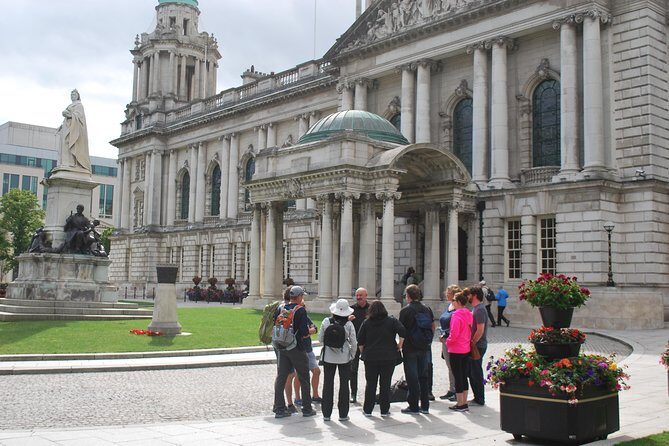
This tour is designed for your “first time in Belfast” brain. In about 2.5 hours, you cover a compact stretch of the city center—about 1.5 miles—with no hills or steps. That matters because it lets you focus on what you’re learning, not on your legs.
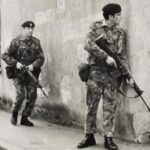
The walking portion is moderate, but the experience is more about listening than bouncing from photo spot to photo spot. You’ll pause frequently, and your guide will frame each location as a piece of a bigger puzzle: relationships between Britain and Ireland, how the Troubles escalated from the late 1960s, and why peace still feels fragile.
You’ll also get a headset system, which is a huge help in city noise. Several stops sit in areas that are active even in daylight, so having clear audio means you can stay present instead of scanning for your guide.
You can also read our reviews of more walking tours in Belfast
Belfast City Hall Start: The Troubles Timeline Starts Here
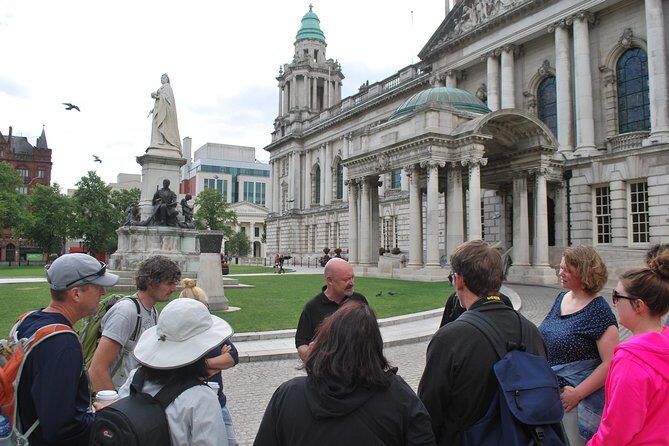
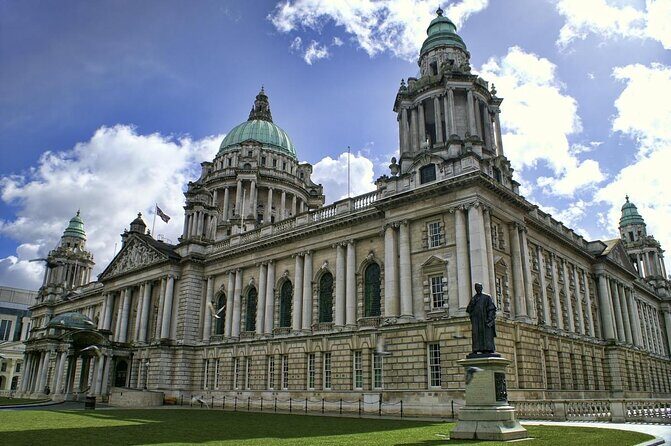
You meet at Belfast City Hall (Donegall Square North, near BT1 5GS) at 10:30 am. From the start, your guide sets context in the grounds around the building. The opening is where you get the timeline: long-running tensions between Britain and Ireland, then the specific reasons the Troubles ignited in the late 1960s.
Why this matters: without that foundation, the rest of the walk can feel like a list of incidents. With the framing, the later stops start to snap into place. You’ll also understand that this wasn’t one sudden event. It was a chain reaction—politics, identity, policing, and retaliation feeding a spiral.
This first stop is also quick (about 20 minutes). You’re not asked to sit for the whole tour. Instead, you get your bearings fast, then you move on.
Donegall Place and Castle Lane: Violence Hiding in Plain Sight
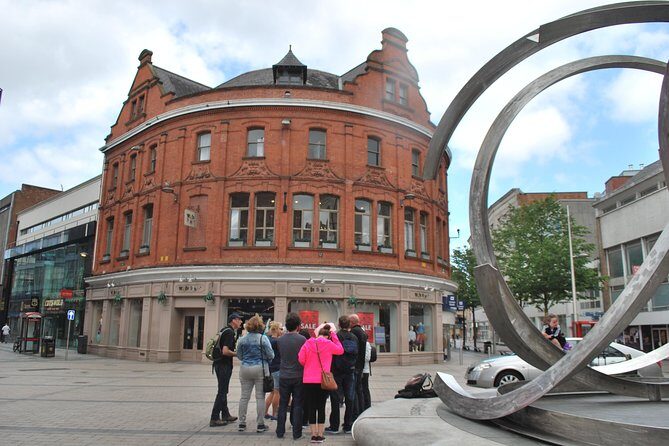
Next you head to Donegall Place, Belfast’s main shopping street. Up close, it can look like any other British or Irish commercial area. That contrast is the point. Your guide explains a nightclub bombing in 1971, then walks through the tragic sequence that followed—plus the introduction of the policy that became known as the Ring of Steel.
Practical tip: wear shoes you don’t mind being on a concrete city surface for. Even though it’s flat, you’ll be on your feet enough that comfort matters.
After that you move into Castle Lane, in the pedestrian precinct. This stretch is usually lively. During the tour, it turns into a window on what day-to-day life looked like at the height of the Troubles. You’ll hear details about an event that still stays prominent in Belfast memory, and you’ll see how modern shopping can occupy spaces that once held fear and shock.
The drawback here is also simple: because the setting is public and busy, you may not always feel perfectly quiet. Headsets solve most of that, but mentally, expect a more reflective mood than a relaxed stroll.
Spirit of Belfast and the 1971 Spark That Escalated Everything
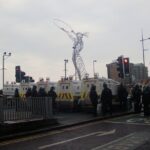
At Spirit of Belfast, you’ll stand near a public artwork meant to evoke resilience—though many locals and visitors know it by its nickname, the Onion Rings. Your guide uses the art as a jumping-off point to connect resilience to a specific escalation story from 1971.
You’ll hear how events that began in a bar nearby acted like a catalyst, helping push Northern Ireland into a rapidly worsening cycle of violence. The guide doesn’t treat this like trivia. The lesson is about momentum—how quickly conditions can change once anger and fear take over.
What I like about this stop is the way it forces you to notice the present without pretending the past isn’t there. You’re standing in a cheerful public space, and the explanation quietly refuses to let you forget what it replaced.
Cathedral Quarter: Street Art, Nightlife, and a Peace Path
Then the tour turns into the Cathedral Quarter, one of Belfast’s regenerated cultural and nightlife zones. This is where you get both sides of the story: the modern energy and the older emotional weight under it.
You’ll walk among streets and alleys where you’ll often see street art and murals, and your guide uses that walk to talk about more significant events while also explaining the beginnings of the path to peace. The contrast can be striking. The streets look like they’re built for fun, and yet the guide keeps pulling you back to the 1970s—so you understand what kind of risk and restraint it took to move away from that era.
One good reason to do this tour now: it changes how you interpret what you see later. If you come back after the walk, the Cathedral Quarter doesn’t feel like scenery. It feels like a result.
You can also read our reviews of more city tours in Belfast



Ann Street and the Police Presence: From Troubles Policing to Today
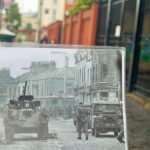
The next stop is Ann Street, standing beside what’s described as the largest police station in Belfast. This is another “don’t just look at the building” moment. Your guide explains how policing worked during the Troubles and how things have changed since the peace agreement.
Then the conversation takes a modern turn: your guide discusses potential Brexit impacts on borders. Even if you’re not tracking UK–Ireland policy closely, you’ll come away understanding the basic concern—how borders and movement matter in places where peace depends on the rules being workable.
This stop is about systems, not only incidents. If you want to understand why violence ended and why it can’t be taken for granted, this is one of the most important parts of the walk.
Beacon of Hope on the Lagan Waterfront: The Ending You’ll Feel
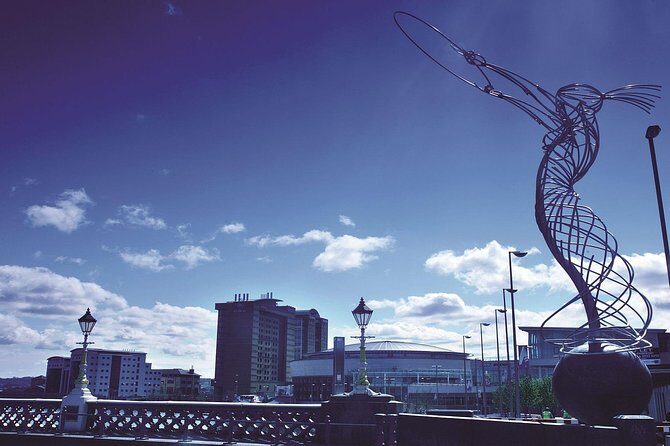
The tour finishes by the Waterfront on the River Lagan, ending at Beacon of Hope on Oxford Street. Your guide brings you back to the contrast between Belfast today and one of the darkest days in its history. Then you’ll talk through how Belfast achieved a fragile peace, plus what the future may hold.
This is the part of the tour that helped me shift from facts to meaning. You’re not left in a loop of tragedy. You’re given a sense of direction: rebuilding, resilience, and the ongoing work of keeping stability.
Timing note: after you finish near Beacon of Hope, it’s just about a 5-minute walk back to City Hall, so you’re not stuck with a long transfer plan at the end.
Price, Pace, and Comfort for a Flat 2.5-Hour Walk
At $36.06 per person, this is one of those “good value or not” decisions where the details matter. Here’s how I’d judge the value:
- You’re paying for a local guide plus headsets (the headsets are a real quality-of-life feature in noisy city centers).
- You get about 2 hours 30 minutes of structured storytelling without long transport time. The route is compact and flat, with moderate walking (about 1.5 miles).
- You’re not spending extra money at the stops. Each location is marked as admission-free.
For planning, also note the group size: it can be up to 25 people. That’s small enough for your guide to manage, big enough that the tour still has a lively feel.
What to wear: bring a waterproof jacket if the forecast even hints at showers. The tour takes place even when weather is not ideal, but you’ll be happier if you can handle damp air. In winter months, warm layers help.
If you’re visiting in the middle of the day, remember your sightseeing time later might be impacted. After this kind of tour, you may want quieter plans for the afternoon.
Who This Tour Fits Best (and Who Might Want a Different One)
This walk is best for you if:
- You want context for Belfast beyond landmarks.
- You like a guided timeline that connects politics, policing, and lived experience.
- You want to understand the present by learning the past without turning it into gore or sensationalism.
It may not be the best fit if:
- You prefer tours that are mostly about architecture and easy photo stops.
- You’re hoping for a light, funny history walk. This one includes real suffering and ongoing political tension.
- You’re very sensitive to emotionally charged stories.
If you do book it, go in with the right mindset: curiosity first, and then space for emotion. The goal is understanding—and for many people, understanding is uncomfortable.
Also, it’s offered in English and the minimum age is 12. Service animals are allowed.
Should You Book This Tour?
Yes—if you want a smart, structured way to understand Belfast’s Troubles-era past in a short amount of time, this tour is a strong pick. The headsets, compact route, and clear timeline approach make it practical, not overwhelming. It ends with a forward-looking tone at Beacon of Hope, so you leave with more than just grim details.
Book it especially if it’s your first day in Belfast City Centre. This walk helps you read the city afterward.
If you’re on the fence, ask yourself one question: do you want history tied to streets and systems? If your answer is yes, this is the kind of tour that will stay with you.
FAQ
How long is the A History of Terror Belfast City Centre Walking Tour?
It runs for about 2 hours 30 minutes.
Where does the tour start and end?
It starts at Belfast City Hall (Donegall Square N, Belfast BT1 5GS) and ends at Beacon of Hope on Oxford Street (Belfast BT1 3NB). From there, it’s about a 5-minute walk back to City Hall.
Is the walking difficult?
No. Belfast City Centre is completely flat, and the tour involves moderate walking of about 1.5 miles. Comfortable footwear is still a good idea.
Do I get help hearing the guide?
Yes. You’ll have headsets so you can hear the guide clearly as you move between stops.
What language is the tour offered in?
The tour is offered in English.
What is the minimum age?
The minimum age is 12 years old.
Does the tour run in bad weather?
The tour will take place regardless of weather, and it’s recommended that you check the forecast and dress accordingly. If the experience is cancelled due to poor weather, you’ll be offered another date or a full refund.
Is there a group size limit?
Yes. The group size is capped at a maximum of 25 travelers.
Is cancellation possible if my plans change?
Yes. You can cancel up to 24 hours in advance for a full refund. If you cancel less than 24 hours before the start time, the amount you paid is not refunded.
Is the tour admission-free at the stops?
The stops listed are marked as admission ticket free, so you should not need to pay entrance fees for those specific locations.
You Might Also Enjoy
More Walking Tours in Belfast


More Tours in Belfast



More Tour Reviews in Belfast
- Titanic Belfast Entrance Ticket: Titanic Visitor Experience Including SS Nomadic
★ 4.5 · 3,698 reviews