REVIEW · BELFAST
Private Belfast Explore Like a Local
Book on Viator →Operated by Giants Causeway Tours · Bookable on Viator
Belfast history hits different when you’re guided. This private 2h40–3h tour pairs hotel pickup with focused stops like the Botanic Gardens Palm House and the murals around the Falls Road, so you learn faster and move easier than doing it on your own. My favorite part is the guide’s close-up storytelling on the Troubles, hunger strikes, and the city’s divided streets. The only real drawback to plan for is that some stops deal with conflict and may feel heavy, even in short doses.
I also like how the driving is handled and the pace stays flexible. On top of that, guides such as Barry and Joe are specifically praised for being passionate, answering questions, and turning big events into something you can actually picture on the street.
In This Review
- Key highlights to know before you go
- Private Belfast logistics: how the tour stays efficient in under 3 hours
- Botanic Gardens and Queen’s Quarter: start with calm, then shift to context
- RISE sculpture at Broadway: Belfast’s modern gateway
- Divis Tower: the Troubles made visible on a skyline
- Peace Walls and Peace Lines: the boundary you can walk up to
- St Peter’s Cathedral and Clonard: faith landmarks with real human stories
- Bobby Sands murals: how public art turns into political memory
- Shankill Road: loyalist streets and how control shaped daily movement
- Belfast Castle and the Albert Memorial Clock Tower: gentler sights with big city symbolism
- Big Fish, cranes, and Titanic Quarter: the riverfront story in steel and ceramic
- Crown Liquor Saloon finish and a quick look at BT9 6RU
- Price and value: is $638.11 per person worth it?
- Who should book this Belfast tour
- Should you book Private Belfast Explore Like a Local?
- FAQ
- How long is the Private Belfast Explore Like a Local tour?
- What’s included in the price?
- Does the tour include hotel pickup?
- Is the tour private or shared?
- What language is the tour offered in?
- Are museum tickets included for Belfast Castle and Titanic Belfast?
- Do I need to print tickets?
- Is airport pickup available?
- Where does the tour end?
- Can I cancel for a full refund?
Key highlights to know before you go
- Private, pickup-included routing: central Belfast pickup and drop-off saves time and hassle.
- Peace Lines and Peace Walls: you’ll see how separation shaped everyday life, not just the headlines.
- Murals with context: Bobby Sands and international political artwork are explained on the spot.
- Historic Belfast in layers: Victorian gardens and universities sit next to modern art and shipyard symbols.
- Shipbuilding landmarks without the full museum time: cranes, Big Fish, SS Nomadic photos, and Titanic Quarter views.
- A satisfying ending at Crown Liquor Saloon: you finish in a classic Victorian gin palace setting.
Private Belfast logistics: how the tour stays efficient in under 3 hours
This is built for people who want a lot of Belfast without the stress of figuring out where to park, which bus to take, or how long each walk will really take. You get round-trip transfer from central Belfast accommodations, plus a private vehicle and a local guide.
That matters because Belfast’s big sights are spread in distinct areas—Queen’s Quarter for the university and Botanic Gardens, west Belfast for the Falls and Shankill interface stories, and then across to the river and shipbuilding zones. With a driver handling navigation, you can spend your energy looking out the window, preparing questions, and stepping out when the moment is right.
It’s also private, meaning you’re not squeezed into a crowd or rushed through stops. That’s a real advantage when the subject is sensitive, like the Troubles. The guide can slow down when you’re taking it in, and speed up when you’re ready.
One more practical detail: you’ll use a mobile ticket, which helps if you’re traveling with a phone full of other apps and don’t want paper.
You can also read our reviews of more private tours in Belfast
Botanic Gardens and Queen’s Quarter: start with calm, then shift to context
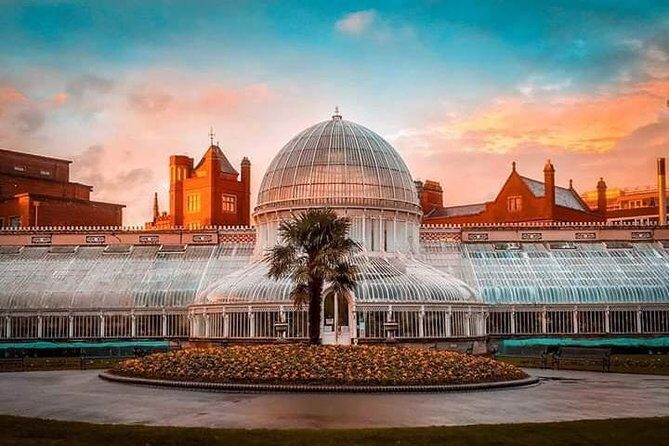
The tour begins with Botanic Gardens, a classic slice of Victorian Belfast and a meeting spot for locals, students, and visitors. The grounds were established in 1828, and the size gives you room to breathe—28 acres in south Belfast.
You’re not just looking at trees here. The big reason this stop gets included is the Palm House. It’s one of the earliest curvilinear cast iron glasshouses in the world, with construction milestones in the late 1830s and early 1840. Even if you only spend a short time, it helps you understand Belfast’s old confidence: horticulture as a public-facing pride project.
Right after that, you head into Queen’s Quarter for Queen’s University Belfast. The university was chartered in 1845 and opened in 1849 as Queen’s College, Belfast. The area’s university focus shows why this part of town feels different: it’s not just history buildings—it’s living streets with students nearby.
The guide also gets you past the “pretty campus” view. You learn how the university’s roots trace back to the Belfast Academical Institution founded in 1810, and how Queen’s College was part of a broader model for higher education in Ireland at the time. If you’re the type who likes to connect past to present, you’ll appreciate this stop because it explains what Belfast invested in—and why.
Time-wise, Botanic Gardens gets you around 30 minutes, and Queen’s University about 15.
RISE sculpture at Broadway: Belfast’s modern gateway
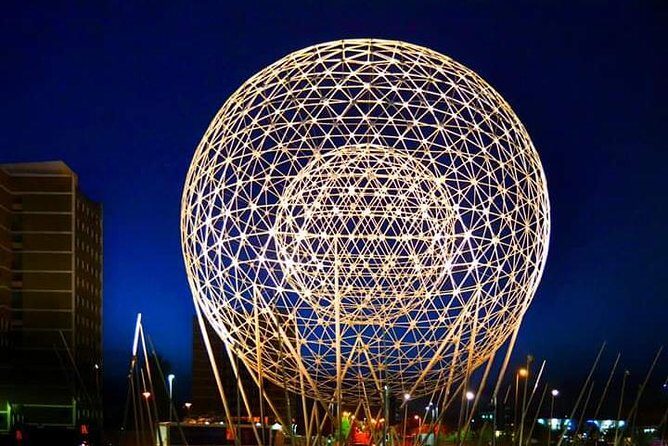
Next is RISE, the massive spherical metal sculpture by Wolfgang Buttress. It’s built to be seen from far away—37.5 meters high—and it sits right at a heavy-flow road junction near Broadway.
This is one of those stops that seems fast until you notice what it represents. Art at that scale isn’t accidental. It signals a city rebranding itself, using public art to mark an arrival point, not just a place you pass through.
And yes, you’ll hear the local nickname energy too—people call it things like The Balls on the Falls, because of where it sits relative to the Falls Road access routes.
Expect about 10 minutes here. It’s a quick “get your bearings” moment before the tour turns darker.
Divis Tower: the Troubles made visible on a skyline
Then you reach Divis Tower, an instantly recognizable vertical landmark near the interface between the Falls Road and Shankill Road. It’s a 20-floor tower built in 1966 as part of the Divis Flats complex—designed to house large numbers of people, and later becoming a flashpoint during the Troubles.
This stop is short—around 15 minutes—but it carries a lot of weight. The British Army had an observation post on the roof in the 1970s, and during the height of the conflict, access was extremely restricted. The guide’s job is to help you understand what that meant for daily life, not just recount the events.
You’ll also hear about specific tragedies tied to the tower, including the killing of Patrick Rooney, described as the first child killed in the Troubles, and later the killing of Emmanuel McClarnon by an Army sniper from the tower.
If you’re coming to Belfast for murals and architecture, this is the point where the city’s conflict becomes unavoidable. It’s also the point where a good guide makes the difference between information and something you can emotionally process.
Peace Walls and Peace Lines: the boundary you can walk up to
This is the core stop for anyone who wants to understand Belfast beyond monuments. The tour includes time at the Peace Wall / Peace Lines areas, where separation barriers, locked gates, and painted messages show how division became part of the street map.
The details are stark. These walls can be up to six meters high, with gates along the length often locked at night. The stated purpose has been to reduce inter-communal violence, but the effect is physical and personal: people live next to a barrier that changes what “normal” means.
You’ll also see why the topic is so sensitive today. Even though the streets may feel quieter than the worst years, the divisions still shape how neighborhoods connect and how people feel passing through.
One included activity here is signing your name and leaving a message of peace and hope. It’s a small gesture, but it’s also a reminder that peace in Belfast isn’t an abstract political phrase—it’s something people try to practice in very concrete ways.
Time at this part of the tour is roughly 30 minutes split across the related Peace Line / Peace Wall stops.

St Peter’s Cathedral and Clonard: faith landmarks with real human stories
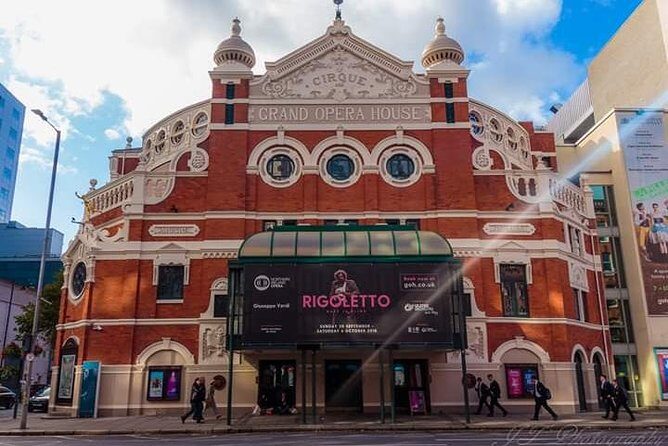
On the Falls Road side, you’ll stop at St Peter’s Cathedral, a Roman Catholic cathedral church for the Diocese of Down and Connor. Construction began in the 1860s, and the twin spires were added in 1886.
The exterior uses Scrabo sandstone with Scottish sandstone dressings. Inside, you’ll find a hammer-beam ceiling. There were multiple refurbishments over time, including major changes in the 1980s and later work in the 2000s. It’s a Grade A listed building, but the best part for most visitors is how the architecture frames community identity.
Then the tour moves into Clonard territory, with two linked stops that add different tones.
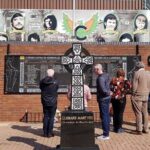
First is Clonard Martyrs Memorial Garden on Bombay Street. This space is built as a memorial, with specific names and dates listed for fallen volunteers and also references to civilian casualties from the Greater Clonard area. The garden is divided into yards, with Celtic crosses and a series of plaques and inscriptions tied to multiple groups remembered there.
Second is Clonard Monastery, a Catholic church and monastery linked to the Redemptorists. A key detail here is that during the Belfast Blitz, more than 300 Protestants from the nearby Shankill area hid in the crypt. This is one of the most powerful “history is not one-note” reminders on the tour, because it shows that even when communities were divided, people still found ways to save one another.
These are not “look and walk away” stops. They’re places where the guide’s pacing matters, and where you might want a moment to stand quietly before continuing.
Bobby Sands murals: how public art turns into political memory
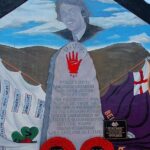
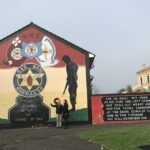
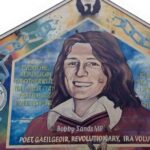
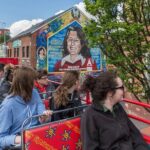
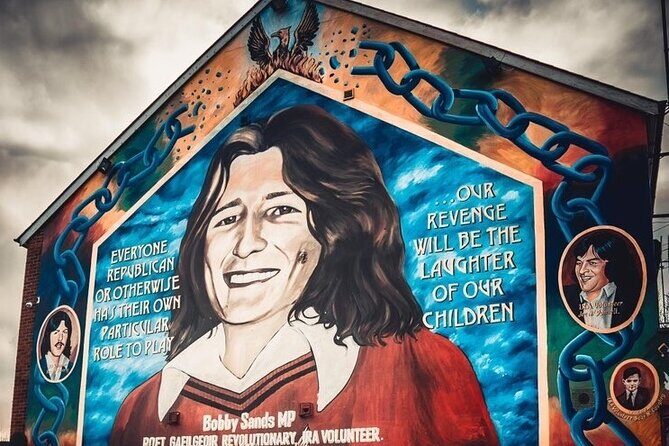
No Belfast street tour feels complete without murals. The tour includes a photo opportunity at the famous Bobby Sands mural, with time for you to stand close and learn the story behind the imagery.
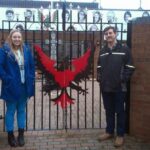
You’ll hear about Sands and the Hunger Strikers, including that he led the 1981 hunger strike and died that same year. The mural’s symbols are explained visually, including a phoenix rising from ashes and other links and insignia-style elements connected to Irish republican identity.
There’s also an International Mural Wall area that’s meant to show how murals can be local and global at the same time, including mention of a Donald Trump mural. Murals in Belfast have been documented since the 1970s, and the tour frames them as communication—what a community wants remembered, what it wants argued, and what it wants to say about current events.
This is also where you’ll feel the emotional temperature. Some murals read like protest posters; others read like memorials. Either way, having a guide to explain what you’re looking at helps you avoid missing the point.
Time here is typically 10 minutes for the Bobby Sands mural and around 30 minutes at the international mural wall stop.
Shankill Road: loyalist streets and how control shaped daily movement
On the other side of the divide sits Shankill Road, presented as the heartland of Ulster loyalism. The road stretches about 2.4 km from central Belfast and runs through a working-class area lined with shops, with streets branching off behind it.
The tour also explains something many visitors only learn after seeing it: parts of the road have been controlled by different paramilitary groups. In this case, the information shared includes that the bottom half is linked to the UDA and the top half to the UVF.
That’s not something you should treat as trivia. It’s part of how the Troubles shaped everyday movement, street life, and what people felt safe doing.
You’re given about 20 minutes here, which is enough time for the street feel without forcing you into long walks.
Belfast Castle and the Albert Memorial Clock Tower: gentler sights with big city symbolism
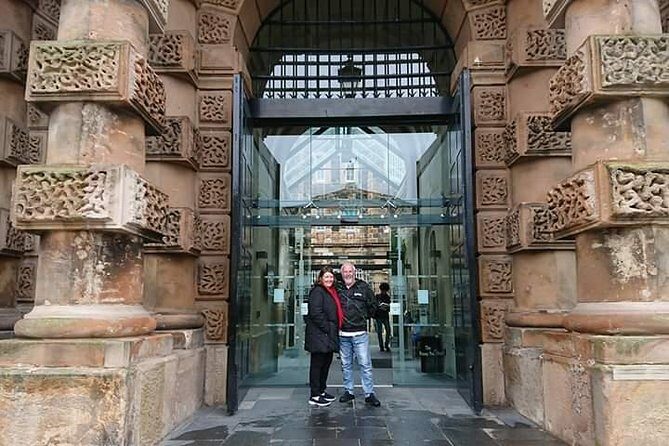
After the emotional stops, you get a more scenic, architectural break.
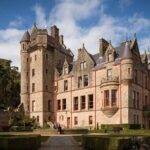
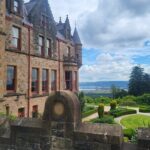
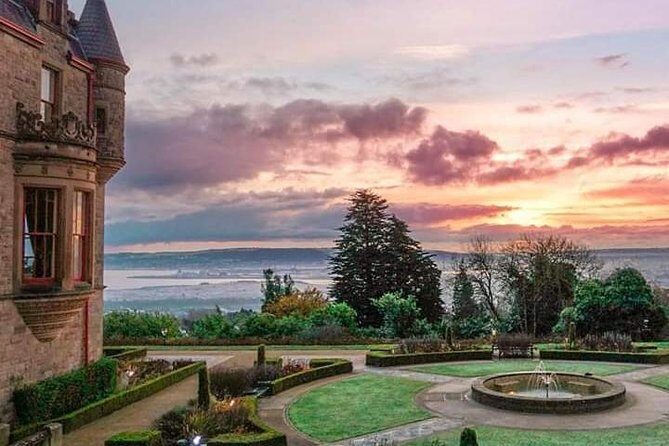
Belfast Castle sits on the slopes of Cavehill Country Park, around 120 meters above sea level, with views over Belfast and Belfast Lough. You’ll also learn about the origin of the site—from a late 12th-century Norman castle that burned in 1708, to the current castle built between 1811 and 1870 in a Scottish baronial style tied to Charles Lanyon and his son.
One fun, very Belfast detail: the Castle’s gardens include a Cat Garden with nine cat sculptures in mosaics and manicured shrubbery. If you’re traveling with someone who needs a lighter moment after the Troubles, this is a good reset.
Important for your budget: the castle stop is listed as admission not included, so you may need to pay separately if you want inside time.
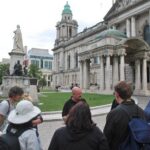
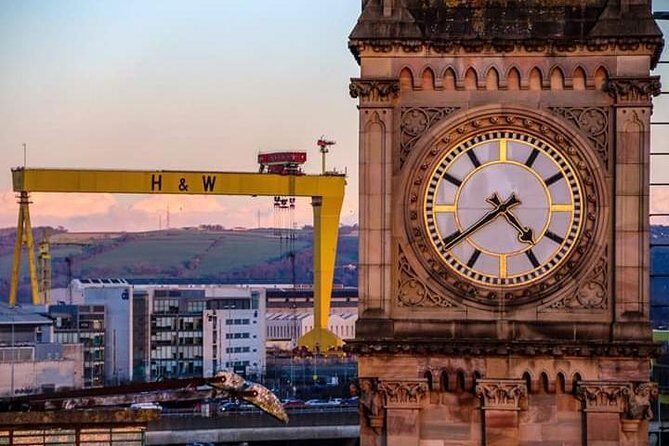
Then you head to Albert Memorial Clock Tower at Queen’s Square. Completed in 1869, it’s one of Belfast’s best-known landmarks. The guide shares the story of its design competition and construction, including that it was built on marshy reclaimed land around the River Farset, which led to the tower leaning about four feet off perpendicular. People even joke about its leaning and the idea that it has the time and the inclination.
This part of town also ties into the “city rewrites itself” theme, with the area around Queen’s Square and Custom’s House Square described as regenerated into modern public spaces.
Time is short here—about 10 minutes—but it’s a great anchor landmark for photos and orientation.
Big Fish, cranes, and Titanic Quarter: the riverfront story in steel and ceramic
The tour shifts into shipbuilding and port-era symbolism with a sequence of quick but meaningful photo stops.
First, you’ll meet Big Fish, a 10-meter-long ceramic mosaic mosaic sculpture called the Salmon of Knowledge. It’s on Donegall Quay near the Lagan Lookout and Custom House. The scales are decorated with text and images about Belfast’s history, and the sculpture includes a time capsule storing information, images, and poetry.
Then comes the shipyard skyline: the twin Samson & Goliath cranes at Queen’s Island, built for Harland & Wolff. These cranes dominate the view—Goliath 96 meters, Samson 106 meters—and were constructed by Krupp, with completion dates of 1969 and 1974. The guide also clarifies a common misconception: the cranes did not host the RMS Titanic, because they were built much later.
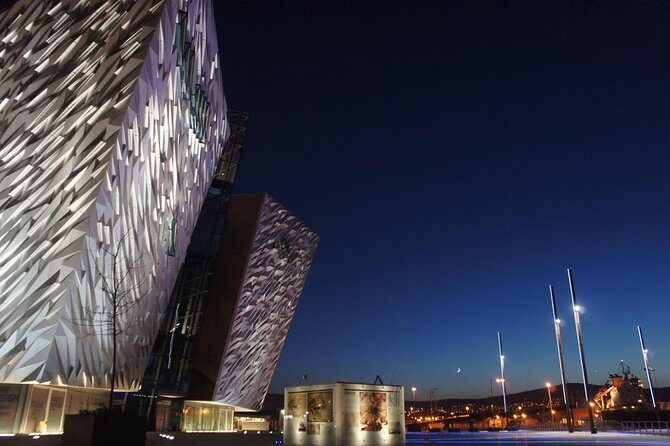
After that, you get to the Titanic Quarter area with photo opportunities at SS Nomadic (the former White Star Line tender launched in 1911) and Titanic Belfast from the outside. The tour doesn’t position these as full museum visits here, so think of them as atmosphere stops unless you choose to add museum time on your own.
This section is quick—often about 10 minutes per stop—but it’s a strong payoff if you like places where Belfast’s industrial past still shapes the present.
Crown Liquor Saloon finish and a quick look at BT9 6RU
To end on something warm and human, the tour stops at Crown Liquor Saloon, also known as the Crown Bar. It’s described as a Victorian gin palace, refurbished in 1885 and considered one of Northern Ireland’s best-known pubs. This is a good moment to grab a drink and decompress while the guide can still answer questions.
Then you’ll get one more quick glimpse: BT9 6RU, described as an affluent address with large mansions. It’s only a short stop, but it adds contrast—Belfast has steep differences between neighborhoods, and this is a quick visual reminder.
If you’re hoping for a “nice ending” after murals and memorials, this works well.
Price and value: is $638.11 per person worth it?
At $638.11 per person for about 2h40–3h, you’re paying for private time plus the guide’s interpretation of Belfast’s most complicated places. That’s the key value: you’re not just buying entry tickets.
Many stops include admission tickets—things like Botanic Gardens, Queen’s University, Divis Tower area stops, Peace Wall / Peace Lines elements, St Peter’s Cathedral, the mural photo opportunities, Albert Clock Tower, Big Fish, Samson & Goliath cranes, and the Crown Liquor Saloon stop.
A few items are marked as not included, including Belfast Castle and the Titanic Quarter photo opportunities for SS Nomadic and Titanic Belfast. If those two museum-style stops matter to you, you may want to plan extra time and tickets separately.
Also, tipping isn’t included, so you should budget for that if you want to thank your guide.
For who it’s most worth it: couples and small groups who want a guided route that covers Belfast’s major zones quickly, while still getting context on the Troubles and murals. If you only want light sightseeing, you might find the subject matter heavier than you expected for this price.
Who should book this Belfast tour
This tour is a good fit if you:
- want a local guide to explain murals, Peace Walls, and key sites in a short window
- like history that connects street corners to big political events
- prefer being driven and dropped off rather than stitching together transit and parking
It’s less ideal if you:
- want a strictly cheerful sightseeing day
- aren’t prepared for stops connected to violence and grief, even when handled respectfully and briefly
Should you book Private Belfast Explore Like a Local?
I’d book it if you want the fastest path to understanding Belfast’s big themes—Victorian Belfast, university life, industrial shipbuilding, and the Troubles—without turning your day into a scavenger hunt.
A quick tip for your decision: ask your guide how they handle balance when discussing the Troubles. One earlier experience shared that a guide can lean into one side’s framing, which can color what you walk away believing. With the right guide, you’ll still get the emotional truth of the places, while also getting enough perspective to make your own judgments.
If your priority is Titanic Belfast as an in-depth museum visit, treat this tour as the “orientation and photo” companion and plan museum time separately.
If that sounds like your style, this is a strong way to see real Belfast—street-level, not just postcard-level.
FAQ
How long is the Private Belfast Explore Like a Local tour?
It runs about 2 hours 40 minutes to 3 hours.
What’s included in the price?
You get a local qualified guide, private transportation, central Belfast free pickup and drop-off, and admissions for many key stops, plus a guided experience that focuses on Belfast’s top sights.
Does the tour include hotel pickup?
Yes, free pickup and drop-off is offered from all central Belfast accommodations.
Is the tour private or shared?
This is a private tour/activity, so only your group participates.
What language is the tour offered in?
The tour is offered in English.
Are museum tickets included for Belfast Castle and Titanic Belfast?
Belfast Castle is marked as admission ticket not included, and Titanic Belfast and SS Nomadic are listed as photo opportunities with admission not included.
Do I need to print tickets?
No. A mobile ticket is included.
Is airport pickup available?
No airport pickup or drop-off is offered.
Where does the tour end?
It ends at the Crown Liquor Saloon.
Can I cancel for a full refund?
Yes. You can cancel up to 24 hours in advance for a full refund.
You Might Also Enjoy
More Private Tours in Belfast


More Tour Reviews in Belfast
- Titanic Belfast Entrance Ticket: Titanic Visitor Experience Including SS Nomadic
★ 4.5 · 3,698 reviews